

What if you could address finances, property, and parenting arrangements without ending your marriage? A legal separation can provide a formal way to resolve important family law issues, but it doesn’t make you single or guarantee that every concern will be protected. People searching “legal separation lawyer los angeles” are often weighing how to formalize arrangements while deciding what they want for the future.
It’s understandable to feel uncertain. Separation and divorce can involve similar decisions, yet they have different consequences, and your first steps may affect your future choices. In California, legal separation leaves the marriage intact, so you can’t remarry, while a court may address issues such as property, support, and child custody.
This article explains what legal separation can and can’t do, what to consider before filing, and how it compares with divorce. You’ll also learn what to discuss with a Los Angeles family law attorney, including your financial priorities, parenting needs, and longer-term plans. Individualized guidance can help you assess whether separation fits your situation without assuming it’s the right answer for everyone.
Key Takeaways
- Learn how a court-ordered legal separation differs from simply living apart, and why the distinction can matter.
- Consider property, debt, support, and parenting as related but separate issues when weighing your next steps.
- Compare legal separation and divorce against your priorities, including whether you want to remain legally married.
- Before speaking with a legal separation lawyer in Los Angeles, gather key financial and family information to make the discussion more focused.
- Ask about filings, negotiations, and related custody, support, or property concerns so you can plan with a clearer understanding of your options.
What Does Legal Separation Mean in California, and When Might It Help?
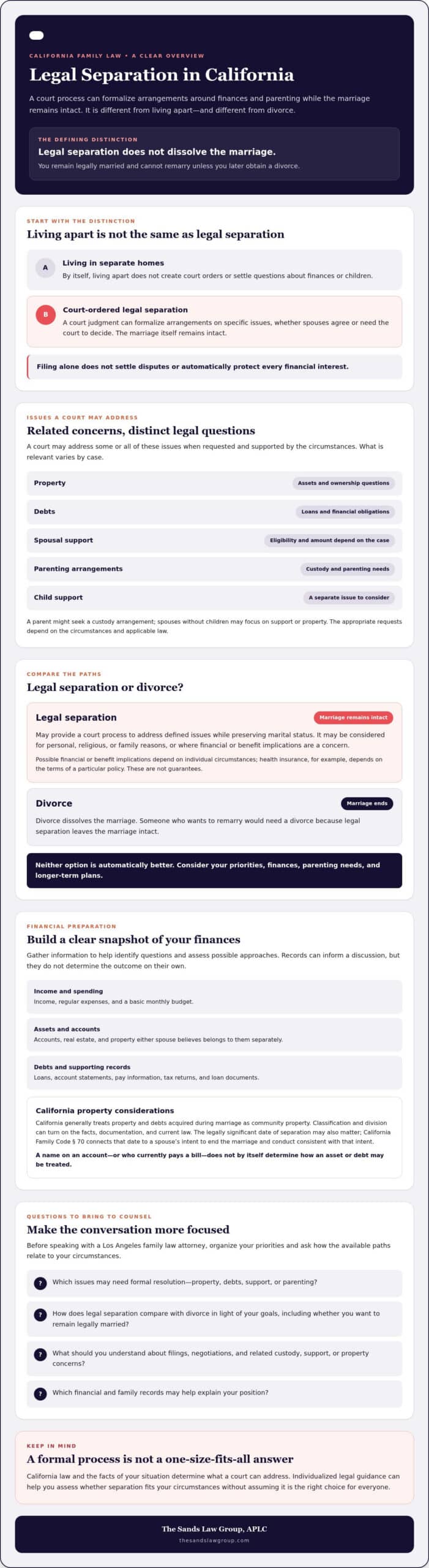
Considering separation can bring personal, financial, and family uncertainty all at once. You may be trying to create stability at home while still deciding whether the marriage should end. In California, legal separation is a court process that can establish a judgment addressing certain issues between spouses, but it does not dissolve the marriage. You remain legally married and cannot remarry unless you later obtain a divorce.
A general overview of legal separation can help explain the concept, but California law and your circumstances determine what a court can address in your case. A judgment may resolve issues such as property, debts, spousal support, or parenting arrangements, depending on what is requested and the facts and evidence. Filing alone doesn’t settle disputes or automatically protect every financial interest.
How is legal separation different from simply living apart?
Living in separate homes, by itself, doesn’t create court orders or settle questions about finances or children. A court judgment can formalize arrangements on specific issues, whether the spouses reach an agreement or need the court to decide. The issues involved vary by case. For example, parents might seek a custody arrangement, while spouses without children may focus on support or property. The appropriate requests depend on the circumstances and applicable law.
Why might someone consider separation instead of divorce?
Some people want formal arrangements while preserving their marital status for personal, religious, or family reasons. Others may be considering financial or benefit implications, which can depend on individual circumstances and, for benefits such as health insurance, the terms of a particular policy. These possibilities aren’t guarantees or a substitute for assessing the consequences of a specific choice.
Legal separation may suit someone who doesn’t want to end the marriage now but needs a court process to address defined issues. Someone who wants to remarry, for example, would need a divorce because separation leaves the marriage intact. Neither option is automatically better. Your priorities, finances, parenting needs, and future plans should guide the decision, along with case-specific advice from a California family law attorney.
If you’re looking for a legal separation lawyer in Los Angeles, ask how separation compares with divorce in light of your goals and which issues may need formal resolution. The Sands Law Group, APLC focuses exclusively on family law and represents clients in divorce and related family law matters, including custody, support, and property disputes. Counsel can help assess possible paths, but only an individualized review can address how the law applies to your situation.
How Can Legal Separation Affect Property, Support, and Parenting?
A separation can raise several connected concerns, but property, debts, spousal support, child custody, and child support are distinct legal questions. A court may address some or all of them when requested and supported by the circumstances. Filing doesn’t automatically settle every issue. Identifying what needs attention and what records may help explain your position is a practical starting point for legal advice.
What financial issues should spouses discuss with a lawyer?
Start by listing income, regular expenses, assets, and debts. Include accounts, real estate, loans, and property either spouse believes belongs to them separately. California generally treats property and debts acquired during marriage as community property, but classification and division can turn on the facts, documentation, and current law. The legally significant date of separation may also matter. California Family Code § 70 addresses that date, which involves both a spouse’s intent to end the marriage and conduct consistent with that intent.
Bring available records, such as account statements, pay information, tax returns, loan documents, and a basic monthly budget. These materials can help counsel identify questions and assess possible approaches, but they don’t determine the outcome on their own. Support eligibility, amounts, property characterization, and timing depend on the individual case. Don’t rely only on whose name appears on an account or who currently pays a bill to determine how an asset or debt may be treated.
Can legal separation address custody and support?
It may. Depending on the case, spouses can ask the court to address parenting arrangements, child support, or spousal support. Parenting decisions require attention to the child’s circumstances and applicable legal standards, while support analysis depends on case-specific financial and family information. Existing orders, schedules, caregiving responsibilities, and safety concerns can all be important to discuss with counsel. No single arrangement or support result applies to every family.
For a focused conversation with a legal separation lawyer in Los Angeles, prepare questions about:
- How assets and debts may be characterized, and what records could clarify disputed ownership.
- Whether support should be considered and what financial information may be relevant.
- What parenting schedule may address the child’s needs, safety, and day-to-day routine.
- How existing court orders or agreements could affect the next steps.
The Sands Law Group, APLC represents clients in family law matters, including divorce and related property, support, and custody disputes. Learn more about The Sands Law Group’s family law representation.
Legal Separation vs. Divorce in California: Which Path Fits Your Goals?
Both legal separation and divorce can involve decisions about property, debts, support, and parenting. The central distinction is your marital status: a legal separation judgment does not itself dissolve the marriage, while a divorce ends it through a court process. The issues addressed and their outcomes depend on what the spouses agree to, what the court orders, and the facts of the case.
| Consideration | Legal separation | Divorce |
|---|---|---|
| Marital status | You remain legally married and cannot remarry. | The marriage ends when the divorce is finalized. |
| Potential court orders | A court may address property, debts, support, and parenting issues, depending on the case. | A court may address similar financial and parenting issues as part of the divorce process. |
| Decision factors | May be worth discussing if preserving marital status is important while seeking formal arrangements. | May fit if your goal is to end the marriage and establish arrangements for life afterward. |
What changes legally if you choose divorce instead?
Divorce formally ends the marital relationship through court proceedings. That change in status does not, by itself, determine how property will be divided, whether support will be ordered, or what parenting arrangements will apply. Those questions depend on the case, including any agreements and court orders. For a broader overview of the stages involved, see this California divorce process guide.
What questions can help clarify your decision?
A comparison can organize your thinking, but it can’t choose for you. Consider what you need now and what you hope your legal and family circumstances will look like in the future:
- Is remaining legally married important to you? If so, what personal, religious, or practical reasons inform that priority?
- What financial arrangements or parenting decisions need attention soon?
- Would ending the marriage support your long-term plans, or are you not ready to make that change?
- Are there agreements, existing court orders, or disputed issues that may shape either path?
Your answers can help a legal separation lawyer in Los Angeles assess which option merits discussion based on your circumstances, rather than relying on a general comparison. Individualized legal advice is especially important when financial interests, children, or future plans make the choice less straightforward.
What Should You Expect When Seeking Legal Separation Counsel in Los Angeles?
A first conversation with a family law attorney is an opportunity to organize the issues, not a test of whether you have every document or answer ready. Counsel can learn what you hope to accomplish, identify disputed questions, and consider possible paths forward based on your circumstances. You can prepare a few key records and questions without trying to manage the legal process on your own.
What information should you bring to an initial legal consultation?
A concise overview is often more useful than an unorganized stack of paperwork. Consider preparing a relationship timeline, copies of existing court orders, and relevant communications about finances or parenting. Bring available records showing income, assets, debts, and household expenses. Don’t omit information because it seems unfavorable or uncertain. Accurate details help counsel assess the full picture.
Before the meeting, write down your immediate concerns and longer-term goals. For example, you may need to understand how to address a parenting schedule, keep household finances organized, or respond to a disagreement about property. A short list of questions can help you use the discussion effectively.
- What issues need attention first, and what information would help evaluate them?
- Which matters appear agreed upon, and which may be contested?
- What next steps should be considered before making decisions or signing an agreement?
How can a lawyer guide the separation process?
Depending on your needs, counsel may help prepare filings, negotiate proposed agreements, address related custody, support, or property issues, and represent you in litigation. The appropriate approach depends on the facts, your priorities, and the degree of disagreement. A lawyer can explain options and risks, but can’t promise a particular result.
Local procedure matters, too. Venue, required forms, service, deadlines, and court procedures should be checked against current requirements and the details of your case. If your matter will be filed in Los Angeles County, confirm the applicable Los Angeles County Superior Court procedures rather than relying on a general checklist or information from another county. Procedural details can change, and the correct steps depend on the case.
The Sands Law Group, APLC focuses exclusively on family law and represents clients in divorce and related family law matters, including custody, support, and property issues. The firm serves clients in Los Angeles, Riverside, San Bernardino, and Kern. To learn how custody, support, or property representation may relate to your circumstances, ask about the issues you need to address.
Legal Separation Lawyer Los Angeles: Planning Your Next Step
Choosing legal counsel is not only about finding someone who knows family law. You need a lawyer who listens carefully, communicates clearly, understands the issues relevant to your circumstances, and gives a realistic assessment rather than promising a particular result. An initial discussion can help you understand options. It doesn’t require you to choose divorce or commit to a specific path.
The Sands Law Group, APLC focuses exclusively on family law and represents clients in divorce and related matters, including disputes involving child custody, support, and property. Depending on the case, representation may include preparing filings, negotiating a settlement, or proceeding to litigation. The right approach depends on your priorities, the facts, and how much disagreement exists.
What should you ask a legal separation attorney?
Use the conversation to understand how the lawyer would assess your goals and unresolved concerns. You might ask:
- Which facts or documents could affect an initial assessment of my options?
- How might my financial, parenting, or property concerns factor into planning?
- What possible paths forward should I consider, and what remains uncertain?
- How will we communicate about developments, decisions, and next steps?
You don’t need to arrive with every answer. A clear account of what matters most, what feels urgent, and where you and your spouse disagree can make the discussion more useful. Ask for an explanation of possible risks and choices in terms you understand, while keeping in mind that any assessment depends on the information available and may change as facts become clearer.
When is it time to seek individualized legal advice?
Consider speaking with counsel promptly if you have urgent concerns about finances, parenting, safety, or existing court orders. It can also be prudent to seek advice before signing an agreement or making a consequential legal decision, particularly if you’re unsure how it may affect your rights or future options. A legal separation lawyer in Los Angeles can help identify questions that warrant attention and explain how family law representation may relate to your situation.
The first conversation is a chance to discuss your goals and concerns, not a commitment to end your marriage. For individualized guidance on your circumstances and potential next steps, discuss your legal separation questions with The Sands Law Group.
Take a Clear, Informed Next Step
Legal separation can provide a way to address specific family and financial concerns without ending the marriage, but it doesn’t resolve every issue automatically. Divorce, by contrast, ends the marital relationship, and both paths may involve decisions about property, support, and parenting. The right option depends on your priorities, circumstances, and plans for the future.
Before filing, signing an agreement, or making another consequential decision, consider what needs attention now and what information may shape your choices. A legal separation lawyer los angeles can help you understand how California law may apply to your situation and assess possible next steps without assuming that divorce is the only answer.
The Sands Law Group, APLC focuses exclusively on family law and represents clients in divorce and related matters, including property, support, and parenting disputes. The firm serves clients in Los Angeles, Riverside, San Bernardino, and Kern. Discuss your legal separation options with The Sands Law Group, APLC to explore your next step.
Frequently Asked Questions
What is the difference between legal separation and divorce in California?
Legal separation allows spouses to seek court orders on issues such as property, support, or parenting while remaining married. Divorce ends the marriage when finalized. A person who is legally separated cannot remarry. Both processes may involve overlapping financial and family concerns, but the right path depends on your goals and circumstances. A court’s specific orders depend on the case, including the issues raised and any agreements reached.
Can you get a legal separation in California without getting divorced?
Yes. You can pursue a legal separation and remain married without later filing for divorce. A separation judgment may address certain family law issues, but it doesn’t automatically resolve every concern or require you to end the marriage. If your plans change, discuss possible next steps with a California family law attorney. Whether separation fits your situation depends on your priorities, the issues needing attention, and the facts of your case.
Is there a waiting period for legal separation in California?
California has no mandatory waiting period for a legal separation to be finalized, although the time a particular case takes can depend on its circumstances and unresolved issues. Divorce has a different timeline: California law requires at least six months from service of the divorce papers before a divorce can be final. Confirm current requirements and procedures with a lawyer, especially if timing affects your plans or a related court matter.
Do you need a lawyer to file for legal separation in Los Angeles?
You aren’t necessarily required to hire a lawyer to file, but handling a case without counsel means you’re responsible for understanding the applicable forms, procedures, and deadlines. Check requirements against current Los Angeles County Superior Court guidance and the details of your case. Legal advice may be especially useful if you have disputed property, support questions, children, existing orders, or uncertainty about whether separation or divorce better fits your goals.
Can legal separation address child custody and support in California?
Yes. A legal separation case may address child custody, parenting time, and child support when those issues apply. The court’s decisions depend on the child’s circumstances, applicable legal standards, and the information presented. Consider discussing proposed schedules, caregiving responsibilities, safety concerns, existing orders, and relevant financial details with counsel. A parent’s preferred arrangement doesn’t guarantee a particular order, and each family’s situation requires an individualized assessment.
What happens to property and debts during a California legal separation?
A court may address property and debts in a legal separation, but the outcome depends on the facts, records, and applicable California law. The date of separation can be important when assessing which assets or debts may be community property. Gather available account statements, loan records, and information about property acquired during the marriage, including anything you believe is separate. Don’t assume that account ownership alone settles how an asset or debt will be treated.
How do you choose a legal separation lawyer in Los Angeles?
Look for a lawyer focused on family law who explains options clearly, asks about your goals, and gives a realistic assessment without promising a result. Ask what records could affect the initial review, how the lawyer approaches negotiation or litigation, and how you’ll communicate about developments. The Sands Law Group, APLC focuses exclusively on family law and represents clients in divorce and related matters across Los Angeles, Riverside, San Bernardino, and Kern.

Article by
Thomas D. Sands, Esq.
Thomas D. Sands is the founder and CEO of The Sands Law Group, APLC. A California attorney with more than two decades of experience, he represents clients in divorce and family law matters as well as civil litigation and real property disputes. His approach emphasizes attentive, practical, and cost-conscious representation.
Sands is a 2023 Litigator of the Year honoree of the American Institute of Trial Lawyers and a 2023 Lawyer of the Year honoree of the American Institute of Legal Professionals. His firm has also received recognition among the 2025 Best Law Firms in America, a 2026 Benchmark Best of award, and a 2026 Law Firm of the Year honor.









Leave A Comment